

What if a signed agreement doesn’t give your business the protection you expect? PPSR registration can help protect a security interest in goods supplied on credit, but the register entry needs to match the transaction.
Written Terms of Trade matter, but paperwork alone may not establish priority on the Personal Property Securities Register (PPSR). The debtor’s legal name and the collateral description need careful attention, and the record may need to be maintained as circumstances change. That can feel like another admin task, particularly when customer arrangements vary.
This guide explains what PPSR registration does and what it doesn’t do. You’ll learn when it may be relevant to goods supplied on credit, how searches differ from registrations, and which transaction details to review. It also covers practical ways to keep records current through amendments, renewals and discharges. Accurate information and a consistent process can make PPSR administration easier to manage.
Key Takeaways
- PPSR registration records notice of a security interest in personal property, but it doesn’t prove ownership or guarantee an outcome.
- Credit sales, leasing or hiring goods, and secured lending can raise different questions. Assess the transaction before deciding what to do.
- Organise the agreement, debtor’s identity and collateral details before preparing a financing statement.
- Assign someone to maintain the record and review it when transaction details change.
- NZ Cashflow Services supports registration, amendment, renewal and discharge administration for New Zealand businesses.
PPSR registration: What it records and why businesses use it
The Personal Property Securities Register (PPSR) is New Zealand’s online public register for notices of security interests in personal property. Businesses use it to record an interest connected with assets such as vehicles, equipment or stock, making that interest searchable.
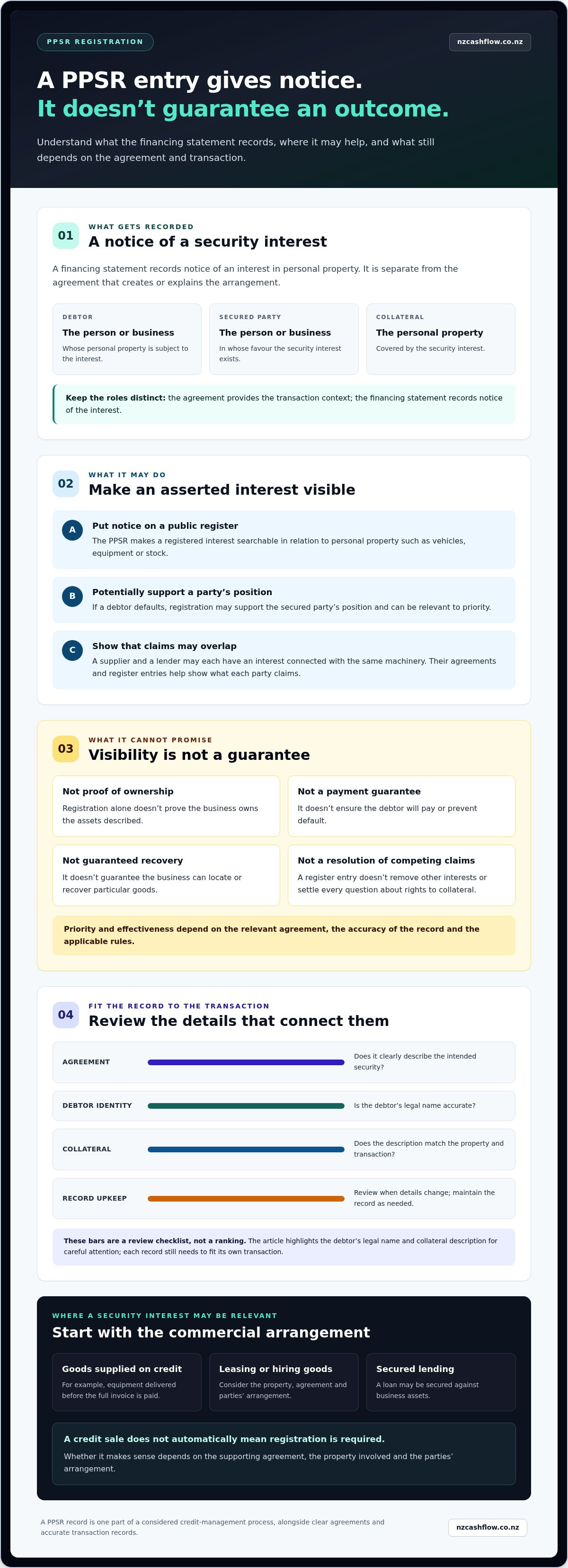
A PPSR registration is a financing statement that records notice of a security interest in personal property. It is not the agreement that creates or explains the arrangement. The agreement and transaction provide the context; the financing statement records notice of the interest. For background on its purpose and operation, see the Personal Property Securities Register (PPSR) in New Zealand.
What does a PPSR registration put on record?
The financing statement identifies the parties and describes the property connected to the security interest. The debtor is the person or business whose personal property is subject to that interest. The secured party is the person or business in whose favour the interest exists. The collateral is the personal property covered by it.
The financing statement is separate from the underlying agreement. A supplier’s credit terms might explain what happens if an invoice remains unpaid, while the financing statement records notice of a security interest in specified goods. The wording and details need to fit the actual transaction. Registration alone doesn’t prove that the business owns the assets or has every right it expects under the agreement.
Which business transactions may involve a security interest?
Consider the commercial arrangement, not just the invoice or contract label. Security interests may be relevant when a business supplies goods on credit, leases or hires goods, or lends money secured against assets. Whether registration makes sense depends on the supporting agreement, the property involved and the parties’ arrangement. A credit sale does not automatically mean registration is required.
For example, an equipment supplier might let a customer take delivery before paying the full invoice. The supplier can review whether its agreement creates a security interest in the equipment and whether recording notice on the PPSR fits the arrangement. If the customer later defaults or becomes insolvent, registration may support the supplier’s position. It doesn’t guarantee payment, recovery of the equipment or a particular outcome.
Other creditors may also have security interests in the same property. A customer could have financed the equipment or granted another creditor an interest over a wider pool of assets. Registration makes an interest visible on the register, but it doesn’t remove competing interests or settle every question about rights to the collateral. Treat it as one part of a considered credit-management process, alongside clear agreements and accurate transaction records.
What PPSR registration can protect, and what it cannot promise
A PPSR record gives public notice that a secured party claims a security interest in personal property. It can make that interest visible and may support the party’s position if the debtor defaults. Registration is not proof that the secured party owns every asset described, and it doesn’t guarantee payment or recovery.
The distinction matters. A financing statement records information about an interest; it doesn’t replace the agreement or establish, by itself, what the parties agreed. The official New Zealand PPSR website explains the register’s role. The effect of a registration depends on the relevant agreement, the accuracy of the record and the applicable rules.
How can more than one party have an interest in the same goods?
Consider a business that supplies machinery on credit while the customer also borrows from a lender using business assets as security. The supplier and lender may each have an interest connected with the same machinery. Their agreements may cover different assets or overlap. The agreements and register entries help show what each party claims, but this example alone can’t determine who has stronger rights.
The order and effectiveness of interests may affect priority under New Zealand’s personal property securities framework. Don’t assume an earlier invoice, possession of goods or a broad security clause settles the question. Check that the agreement describes the intended security clearly and that any financing statement identifies the debtor and collateral accurately. Errors or changes to party details can complicate how a record relates to the transaction.
Does registration guarantee payment or recovery?
No. PPSR registration is not a guarantee that a debtor will pay or that a business can recover particular assets. It may make an asserted security interest more visible and can be relevant to priority, but it doesn’t prevent default, make goods easy to locate or resolve a dispute automatically.
A retention-of-title clause can state that a supplier intends to retain ownership until payment. That wording doesn’t, by itself, settle competing claims or guarantee recovery of the goods. The clause, the transaction and the applicable law all matter. Treat the agreement and registration as parts of a broader credit-control process, alongside clear records and prompt follow-up on overdue accounts.
For a live dispute or a transaction with material exposure, this general overview can’t determine the parties’ rights. Get advice that considers the specific agreements and facts before acting. For routine record administration, PPSR registration support can help keep related entries aligned with business records, without promising a legal outcome.
When should a business consider PPSR registration?
Start with the transaction, rather than assuming every deal needs a registration. Ask what property is involved, what the agreement says and what the business is trying to protect. The New Zealand Government’s guide to the PPSR describes the register as a place to record financial interests in personal property. Whether a particular arrangement calls for action depends on its details.
Use this comparison to identify what to review. It’s a prompt for commercial assessment, not a legal conclusion.
| Transaction type | Business question | Information to review |
|---|---|---|
| Selling goods on credit | Does the agreement create a security interest in the supplied goods? | Goods supplied, customer identity, credit terms and any retention-of-title wording. |
| Leasing or hiring goods | What does the agreement say about the goods and the customer’s use of them? | Asset description, parties, agreement terms and payment arrangement. |
| Secured lending | Which assets are intended to support the lending arrangement? | Loan or security agreement, debtor details and description of collateral. |
| Buying goods | Could the goods be subject to an existing recorded interest? | A PPSR search, the goods’ identifying details and information available from the seller. |
Selling goods on credit, or leasing and hiring them
Before deciding whether to register, identify the goods, customer, agreement and payment arrangement. A supplier providing equipment on deferred payment terms should review the agreement’s security provisions and the assets those provisions cover. A business hiring out machinery should review the same details, including how the contract describes the goods and arrangement.
Retained-ownership wording and a financing statement are separate considerations. A clause in an agreement doesn’t itself put notice on the PPSR, and registration doesn’t replace or rewrite the agreement. Don’t treat either step as automatic. Assess the arrangement and applicable rules together.
Lending, buying goods and reviewing an existing position
For secured lending, check that the agreement and collateral description reflect the assets intended to secure the lending. If the business is buying a vehicle, equipment or other personal property, a PPSR search can help identify financing statements recorded against relevant details. A search is an investigation step, not a registration, and the result needs to be interpreted in context.
Searches can also help a business review an existing position or investigate assets before a transaction. This guide focuses on deciding when the question matters; detailed search steps belong in a separate PPSR search guide.
There’s no universal answer based on transaction type alone. The agreement, asset, debtor details and circumstances can affect whether an interest exists and how priority applies. Assess ppsr registration against the specific transaction, and get legal advice where the effect of competing interests or contractual terms is uncertain.
How to prepare for accurate PPSR registration and record maintenance
Good records start before you enter details on the register. Set a consistent process for checking the agreement, confirming the parties and describing the collateral. This helps your team spot gaps early and gives whoever manages the record a clear reference for future reviews.
What information should a business organise before registration?
Gather the signed agreement and supporting transaction documents first. Then organise the details that connect the proposed financing statement to that arrangement:
- Agreement: Keep the relevant credit, lease, hire or security agreement together with any variations.
- Debtor identity: Confirm the debtor’s correct legal identity against reliable business records. Don’t rely on an informal trading name if the agreement identifies a different legal entity.
- Collateral description: Identify the personal property covered by the agreement. Make sure the description fits the transaction and current PPSR guidance, rather than relying on a broad label that may not clearly identify the intended assets.
- Record owner: Assign a staff member to retain supporting documents, track key dates and coordinate updates.
Before submitting or changing information, use a second-person check or documented review. Compare the debtor and collateral details with the agreement, then confirm the proposed entry reflects the arrangement. A short, repeatable check is easier to apply consistently than relying on someone’s memory.
How can a business keep PPSR records under review?
Build a review into processes your team already uses for credit accounts, contract changes and asset records. For example, flag a debtor name change or revised agreement for review rather than assuming the existing record will still match. Keep a central register of records, supporting documents, review dates and the staff member responsible.
Distinguish three common maintenance actions. An amendment updates information when a record needs to change. A renewal extends a registration before it expires. A discharge removes a registration when it should no longer remain on the register. Each action has a different purpose, so record the reason and keep evidence of the decision.
A financing statement can remain registered for a maximum of five years, so note its expiry date and review renewal well before then. Don’t leave it to a last-minute reminder. Schedule recurring checks for changes to agreements, debtor details and business circumstances, and make sure someone acts on each alert.
For a more detailed checklist, see the related guides on registration mistakes, amendments, renewals and discharges. NZ Cashflow Services provides practical help managing PPSR records, including PPSR registration and record maintenance.
PPSR registration support for New Zealand businesses
Managing a security interest involves more than creating a financing statement. Records need to stay aligned with the underlying transaction as it changes, ends or requires follow-up. NZ Cashflow Services supports New Zealand businesses with PPSR registration, amendments, renewals and discharges, helping organise this administration alongside day-to-day credit management.
What PPSR administration support can help businesses manage
Each action serves a different point in a record’s lifecycle. Registration records notice of an interest; an amendment updates a record; renewal extends a registration before expiry; and discharge removes a registration when it should no longer remain. Practical help with these tasks can reduce the administrative load for teams managing multiple customer arrangements and supporting documents.
Good administration also links PPSR records with wider business routines. A team can keep agreements, customer details and record dates together, then flag changes for review. That makes it easier to see which entry relates to which transaction and who is responsible for the next action. It supports organised credit management, but doesn’t determine legal rights or promise priority, payment or recovery.
Support is particularly useful when responsibility is shared across sales, accounts and credit staff. A shared process helps reduce the risk of overlooking a registration after goods are supplied, missing an amendment after details change, or leaving a record active after the relevant arrangement ends. The aim is practical consistency, not a substitute for reviewing the agreement itself.
Choose a practical next step for your business
Start by identifying the transaction you’re managing. Is it a new supply arrangement, a change to an existing record, an approaching expiry, or an interest that may need discharging? Gather the relevant agreement and record details, then identify who in your business owns the follow-up. A clear starting point focuses the administration and helps avoid unnecessary back-and-forth.
If you’re reviewing your wider process, connect PPSR recordkeeping with your credit terms and account-management routines. Set a regular review point, make responsibility clear and keep supporting documents easy to locate. For questions about a particular dispute or the legal effect of an agreement, seek advice based on the facts of that situation.
NZ Cashflow Services provides PPSR administration support to businesses across New Zealand. For practical help with ppsr registration or ongoing record management, explore PPSR support for your business.
Build PPSR checks into your next credit decision
Make PPSR administration part of how your business assesses a new customer or changes its trading terms. A clear process helps staff pause at the right point, gather relevant records and identify who owns the next action. That’s more useful than treating ppsr registration as a one-off task separate from everyday credit decisions.
Choose an upcoming transaction and use it to test your approach. Are the agreement and customer details easy to find? Is responsibility for the record clear? A small process improvement can make future decisions easier to manage as customer relationships and records change.
NZ Cashflow Services helps New Zealand businesses manage PPSR administration as part of practical credit management. Take the next step: explore PPSR support for your business.
With a workable process in place, your team can handle each new decision with greater clarity and confidence.
Frequently Asked Questions
What is PPSR registration in New Zealand?
PPSR registration records a financing statement about a security interest in personal property, making the notice searchable on New Zealand’s Personal Property Securities Register. It doesn’t replace the agreement or prove ownership on its own. Keep the agreement and related transaction records alongside the financing statement so staff can see what the record relates to. The effect in a specific dispute depends on the facts and applicable law.
Who can register a security interest on the PPSR?
A party with a security interest may need to consider registering it, depending on the agreement and circumstances. This can arise in some arrangements involving goods supplied on credit, leased or hired goods, or lending secured against assets. An overdue invoice alone doesn’t establish that a registrable interest exists. Before acting, identify the parties, goods and relevant agreement, then follow current official requirements for that transaction.
Does PPSR registration mean that I own the goods?
No. A registration isn’t an ownership certificate and doesn’t transfer title to goods. For example, a financing statement against equipment doesn’t by itself show who bought it, what the sale terms were or whether another party has rights in it. Keep purchase records, contracts and payment information available if ownership becomes unclear. The legal effect of those documents depends on the transaction, so don’t rely on a register entry alone to settle a dispute.
Does PPSR registration guarantee that a business will recover its goods or money?
No. PPSR registration doesn’t guarantee payment or recovery of goods. A business may still face difficulty if a customer defaults, assets can’t be located or another party claims an interest. The agreement, the accuracy and timing of the record, competing interests and applicable law can all affect the position. If a customer disputes your claim or you’re considering recovery action, get advice based on the specific facts rather than relying on a general guide.
Can a business register an interest over land on the PPSR?
The PPSR is for security interests in personal property, not land or buildings. Don’t treat a PPSR entry as a way to record an interest in real property. If an arrangement involves both land and movable assets, review the assets separately rather than assuming one register covers everything. Some asset classifications can need closer interpretation, so check the current statutory scope before relying on a conclusion about a particular transaction.
Can I search the PPSR using a company name?
You can start from company information and use the Companies Office search pathway to reach PPSR information. Its company-search inputs include a company name, company number or NZBN. A result may show financing statements associated with the debtor, but it isn’t a complete assessment of a particular asset or transaction. Match the result against the goods and relevant records, and follow current official guidance for the search process.