

Could one incorrect debtor or collateral detail leave your PPSR filing doing less than you intended? If you’re searching for how to register security interest PPSR, start by checking that your commercial arrangement supports a registrable security interest, then prepare the required details before lodging. A filing doesn’t replace the agreement behind it, and errors may affect whether it protects your business as intended.
It’s sensible to understand the process before entering information online. This guide covers the New Zealand steps, from reviewing the arrangement and gathering grantor, secured party and collateral details to setting up PPSR access with a RealMe login.
You’ll also learn what to check after lodging, including whether the registration matches your records and when an amendment or practical registration support may be useful. Following a consistent workflow makes each step easier to complete and review.
Key Takeaways
- Check that your commercial agreement supports a security interest. A PPSR filing records that interest; it doesn’t replace the agreement.
- Prepare the grantor, secured party and collateral details before opening the registration form. Verify grantor information against authoritative records.
- Follow a clear New Zealand filing workflow, from signing in to selecting the correct secured party group.
- Compare the registration confirmation with your agreement and filing records to identify details that may need attention.
- Keep the process manageable with organised records and practical PPSR registration support for your business.
Before registering a security interest on the New Zealand PPSR
Before opening the registration form, establish what your business arrangement is intended to protect. New Zealand’s Personal Property Securities Register (PPSR) is a searchable, government-run register for security interests in personal property. Businesses use it to record interests linked to goods or other personal property, including in credit sales, leases and lending arrangements. The Personal Property Securities Register (PPSR) in New Zealand overview provides background on the register’s purpose and functions.
A PPSR filing records information about an interest. It doesn’t create the underlying commercial agreement, supply missing terms or determine what the parties agreed. Before considering how to register security interest PPSR, review the contract and identify the property, parties and obligations it covers. Whether an interest can be registered, and what effect registration may have, depends on the particular arrangement and current New Zealand law. Check current Companies Office guidance, and seek legal advice if the terms or their effect are uncertain.
What information does PPSR registration make visible?
A registration is a public record associated with a grantor and a description of the collateral. It is made through a financing statement. The statement records information on the register, separately from the agreement that establishes the parties’ rights. For example, a supplier may agree to provide equipment on credit and include terms relating to that equipment. A PPSR registration can make the recorded claim searchable, but it doesn’t prove every detail of the agreement or guarantee that the supplier will recover the goods or money.
Is a contract or retention-of-title term enough on its own?
Contract terms and PPSR registration serve different purposes. A retention-of-title clause may set out what the supplier and customer have agreed about ownership until payment. Registration creates a public record that others can find when searching the register. A supplier relying only on contract wording may still face questions if a lender or another supplier has an interest in the same goods. The legal effect depends on the wording, facts and timing, so check the position against current New Zealand sources.
Before starting the online process, work through this short check:
- Identify the arrangement: Is it a credit supply, lease, loan or another commercial deal involving personal property?
- Read the agreement: Which goods or property are covered, and what does the agreement say about the parties’ rights?
- Resolve uncertainty early: If you can’t tell whether the arrangement supports a registrable interest, confirm the position before filing.
This groundwork matters because a financing statement records details; it doesn’t fix an unclear agreement or determine competing claims. Treat registration as one part of a considered process, alongside reviewing the commercial terms and current New Zealand guidance.
Prepare your grantor, collateral and PPSR account details
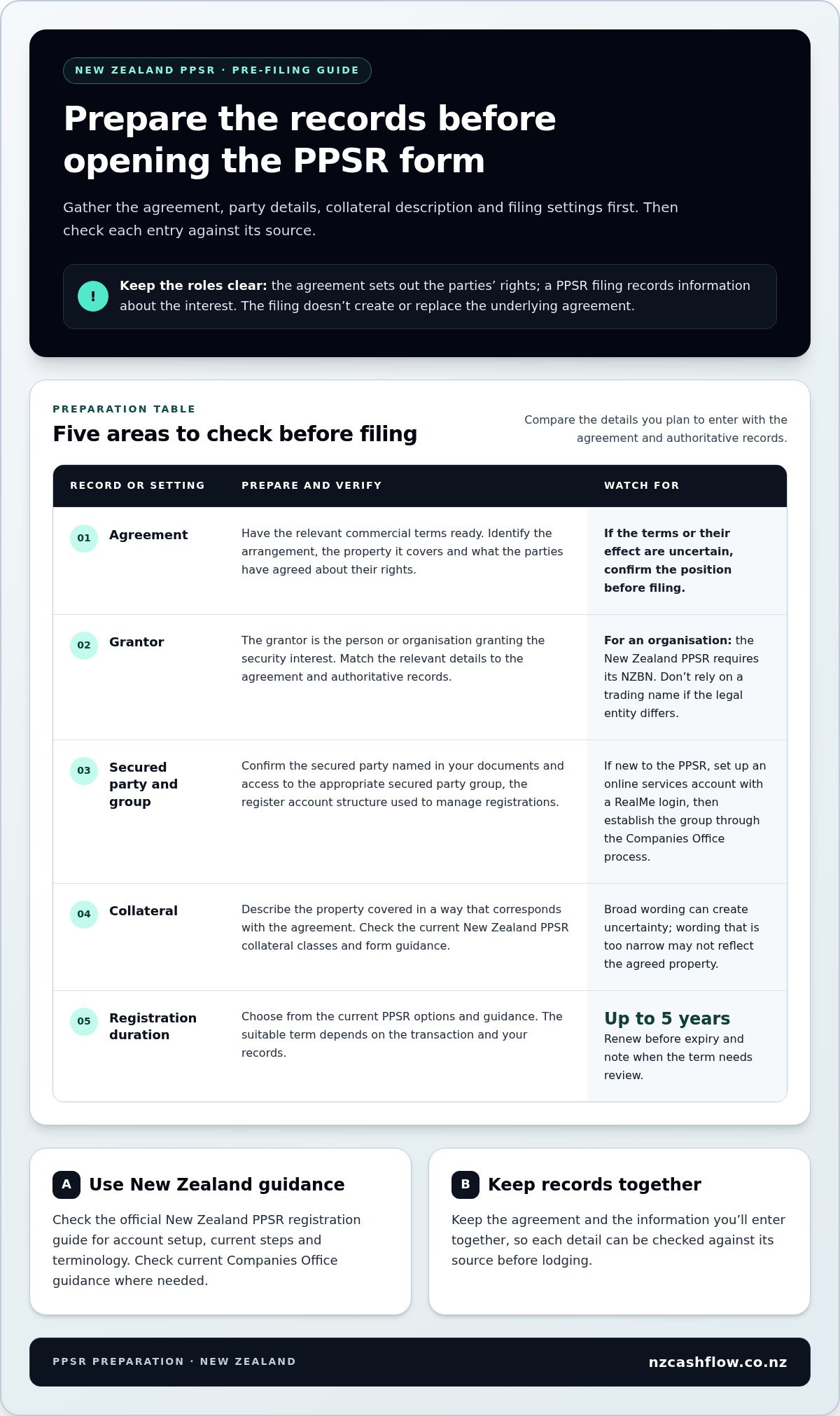
Good preparation reduces the risk of stopping midway or entering details that don’t match your records. Before opening the New Zealand PPSR form, gather the agreement, the parties’ correct legal details, a clear description of the property and your proposed registration settings. Keep the documents and information together so you can check each entry against its source.
The official New Zealand PPSR registration guide explains account setup and the register’s current steps and terminology. Use its instructions rather than relying on guidance written for another country’s register.
Identify the grantor and secured party group
The grantor is the person or organisation that grants the security interest under the agreement. Use the grantor details relevant to that agreement, then compare them with authoritative records. For an organisation, the New Zealand PPSR requires its New Zealand Business Number (NZBN). Don’t rely on a trading name if the agreement and official record identify a different legal entity.
A secured party group is the register account structure used to manage registrations for the secured party. Before filing, make sure you can access the appropriate group and that its details match the party named in your documents. If your business hasn’t used the PPSR before, set up an online services account with a RealMe login, then establish the group through the Companies Office process.
Describe the collateral and choose filing details
Describe collateral in a way that corresponds with the agreement and identifies what the interest covers. Broad wording can create uncertainty, while wording that is too narrow may not reflect the agreed property. Check the current New Zealand PPSR collateral classes and form guidance before choosing a category. Don’t copy labels or assumptions from Australian PPSR material, because the register and rules are jurisdiction-specific.
Choose the registration duration using the current PPSR options and guidance. A financing statement can be registered for a maximum of five years and renewed before expiry. The suitable term depends on the transaction and your records, so note when it needs to be reviewed.
Use this checklist before you start:
- Agreement: Have the signed or relevant commercial terms ready.
- Grantor: Match the name and identifier to the agreement and authoritative records.
- Secured party: Confirm the correct party and secured party group.
- Collateral: Record what property is covered and check the current category guidance.
- Filing choices: Review the available duration and any applicable status fields.
Pay particular attention to any question about a purchase money security interest (PMSI). Its treatment can affect the filing, and whether the arrangement qualifies is a technical question. Check the current New Zealand requirements before selecting a PMSI option. Don’t assume that supplying goods on credit is enough.
Once your source documents and account details are organised, you can follow how to register security interest PPSR without guessing at fields. If you need help with the process, NZ Cashflow Services provides PPSR registration support to make registration more manageable.
How to create and lodge a New Zealand PPSR registration
With your agreement and filing details ready, lodge the financing statement through the New Zealand Companies Office PPSR. Follow the instructions in the live service, as screen layouts and prompts can change. The steps below outline the sequence without relying on labels that may differ from the current form.
Enter the financing statement details
Sign in to your Companies Office online services account and open the PPSR. Select the secured party group that matches the secured party in your agreement. Start a registration and work through the form’s current prompts. Use your prepared records to enter the grantor, secured party, collateral and other required details. For an organisation grantor, have its NZBN ready.
- Choose the registration function. Select the option to register a financing statement, rather than manage an existing registration. Before proceeding, check that you’re working in the correct secured party group.
- Enter the grantor details. Copy the relevant name and identifier from your verified records, and compare them with the agreement as you go. Take care with similar company names, trading names and individual names.
- Describe the collateral. Choose the applicable category from the current New Zealand form and follow its guidance. Keep the description consistent with the property and terms covered by your agreement. Don’t rely on Australian form labels or assume a category applies because its wording sounds familiar.
- Complete the remaining prompts. Use your source documents to answer each required field, including questions about registration duration or PMSI status. If you’re uncertain about an answer or its legal effect, pause and check current New Zealand guidance before lodging.
- Review the on-screen summary. Compare each displayed detail with your agreement and records. Check the grantor, secured party group, collateral description and other selected terms. Correct discrepancies before submitting.
Submit the registration and keep a record
Submit only when the summary matches your source documents. A successful lodgement should produce a confirmation or other reference information in the service. Save or print the confirmation, note the registration reference if displayed, and file it with the agreement and supporting records. This will make the filing easier to identify later.
Submitting the form doesn’t prove that the arrangement is legally effective or guarantee payment or recovery. The filing records the information entered; its effect depends on the agreement, the accuracy of the details and applicable New Zealand law. If the service reports an error, resolve it using the PPSR instructions before relying on the registration. A careful lodgement also leaves a clear record for the review stage.
Review your PPSR registration before relying on it
Lodgement isn’t the final check. Compare the registration confirmation with the agreement and the details you entered. Reviewing the record while the source documents and filing details are close at hand makes it easier to spot a mismatch. Keep the confirmation with the agreement so it’s easy to locate later.
What should you check in the registration record?
Use the confirmation and the New Zealand PPSR record to verify that the registration appears as expected. Check each detail against its source, not just your memory of what you entered. If something doesn’t match, don’t assume the filing will be understood as intended. Follow current Companies Office guidance to identify the appropriate next step.
- Grantor: Confirm the name and identifier match the agreement and authoritative records.
- Collateral: Check that the description and selected category reflect the property covered by the agreement.
- Secured party group: Make sure the record is linked to the intended group.
- Recorded term: Compare the term shown with the option you selected and your filing notes.
- Filing status: Confirm the registration has been lodged and appears in the PPSR record.
Keep the confirmation, registration reference if provided, relevant agreement and supporting records together. This gives your team a reliable file to consult if you need to review the registration, correct information or manage it later.
What does registration not guarantee?
A PPSR registration doesn’t ensure a customer will pay, make goods available or guarantee that your business can recover money or property. The confirmation alone also doesn’t establish that you have priority over another party. The outcome can depend on the agreement, the facts, timing and competing interests. A filing is one part of the picture, not a substitute for considering the underlying rights.
If a detail is wrong or has changed, use the appropriate PPSR process. An amendment may be needed to update a registration. Renewal is a separate task to complete before a financing statement expires, while discharge applies when a registration should be removed. These are later maintenance actions, not substitutes for checking the original filing after lodgement.
For a straightforward review, match the confirmation to the source documents and record any follow-up action. If you’re dealing with a disputed interpretation, competing claims or a complex priority question, seek advice from a qualified legal adviser. A general filing checklist can’t resolve a legal issue.
NZ Cashflow Services supports New Zealand businesses with PPSR registration, amendments, renewals and discharges. Learn about PPSR registration support for managing the filing process.
Keep the PPSR process manageable with practical registration support
A dependable PPSR routine has three parts: prepare the transaction records, lodge the financing statement through the New Zealand PPSR, then retain and review the confirmation. This gives you a practical workflow for how to register security interest PPSR. Use it for each relevant transaction, and make checking the details part of the process rather than an afterthought.
When practical registration support can help
Managing registrations takes time, particularly when staff are handling repeated filings alongside day-to-day work. NZ Cashflow Services supports New Zealand businesses with PPSR registrations, amendments, renewals and discharges. Practical registration support can help manage the administrative steps. It doesn’t replace the agreement behind the interest or guarantee payment, recovery or priority.
Before each filing, keep the source documents close and follow a consistent sequence:
- Prepare: Gather the relevant agreement and verify grantor and secured party details against your records.
- Lodge: Use the New Zealand PPSR process and select the correct secured party group.
- Review: Compare the registration confirmation with the agreement and information entered.
- Retain: Store the confirmation with the transaction records so it can be found when needed.
This routine gives your team a clear handover point. Someone else can see which source documents informed the filing, what was lodged and where the confirmation is stored. If a detail needs changing, the record helps identify the registration and the appropriate follow-up.
Build a repeatable PPSR administration routine
Keep agreements, grantor details, filing confirmations and follow-up notes together in a consistent place. Record the registration term and schedule a review so renewals don’t slip through unnoticed. If transaction details change, consider whether an amendment is needed. If the registration should be removed, consider the discharge process. Check current New Zealand PPSR guidance for the relevant steps.
Support can be useful when registration tasks are taking staff away from other work or your business handles filings regularly. For questions about the legal meaning of an agreement or a disputed priority issue, seek advice from a qualified legal adviser. Registration assistance can help with the PPSR process, but it doesn’t determine legal rights or promise a particular outcome.
For practical help with registrations and related PPSR administration, explore NZ Cashflow Services’ PPSR support.
Make PPSR administration part of your next transaction
Set a clear point in your workflow to consider PPSR requirements whenever your business agrees to supply, lease or finance goods. This brings the relevant records and decisions into the transaction process, rather than leaving them until paperwork builds up. Keep responsibility clear within your team and make each filing easy to trace later.
If you’re deciding how to register security interest PPSR for a current transaction, use the process in this guide as your starting point. Where filing administration is taking time away from other work, NZ Cashflow Services supports New Zealand businesses with PPSR registrations, amendments, renewals and discharges. This is practical process support, not a promise of payment, recovery or a particular legal outcome.
Make your next filing easier to manage. Get practical PPSR registration support from NZ Cashflow Services.
Frequently Asked Questions
Can registering a security interest on the PPSR guarantee that my business will be paid?
No. Registration doesn’t make a customer pay or guarantee that you’ll recover goods or money. A customer may still be unable to pay, for example, or the relevant goods may be subject to another party’s interest. Treat registration as one part of your credit and contract process. Set clear payment terms, keep transaction records and follow up overdue invoices through your usual procedures.
Does a PPSR registration create the security interest itself?
No. The registration records information about an interest; it doesn’t replace the arrangement that gives rise to it. Entering equipment details on the PPSR, for example, won’t add missing terms to a supply agreement. Make sure the documents reflect the transaction and the property involved. If you’re unsure how the agreement operates under New Zealand law, seek advice from a qualified legal adviser.
Can a New Zealand business use Australian PPSR instructions to register in New Zealand?
No. New Zealand and Australia have separate registers, filing processes and legal frameworks. Australian guidance may explain general concepts, but its form fields and instructions aren’t a reliable New Zealand checklist. Use the New Zealand Companies Office guidance for account setup and filing steps. If you’ve started a filing using overseas instructions, pause and compare each choice with the current New Zealand form before submitting.
What is a secured party group on the New Zealand PPSR?
It’s an account structure used to manage registrations associated with a secured party. It isn’t the agreement that creates the security interest. A business managing filings for more than one secured party, for example, should take care to select the group relevant to the transaction. Follow the Companies Office setup instructions and check the group name before lodging so the filing is managed under the intended account structure.
Can a supplier register a retention-of-title interest on the PPSR?
A supplier may have an interest connected with goods supplied under a retention-of-title arrangement, but the agreement and current New Zealand rules matter. A clause referring to ownership until payment doesn’t, by itself, resolve what happens if another party also claims an interest in the goods. Check the agreement and relevant guidance before filing. Seek qualified legal advice if the wording or timing could affect your rights.
What should I do if the registration information does not match my agreement?
Compare the filed record with the agreement and the source records used for the filing. Identify exactly what differs, such as a grantor identifier, collateral detail or selected account group, and make a note of the discrepancy. Don’t assume an internal correction changes the register. Check current Companies Office instructions for the appropriate action. If the mismatch could affect your rights, seek qualified legal advice before relying on the record.
