

A PPSR registration can look like protection on paper and still fall short if the interest, details or follow-up aren’t right. For New Zealand businesses, PPSR nz is relevant when you supply goods on credit, lease equipment or finance assets. Knowing when to register and when to search starts with understanding the transaction and the role of the register.
Registering an interest and searching the register serve different purposes, and neither guarantees payment or recovery. The PPSR can help protect your position, but its value depends on the underlying arrangement, accurate information and keeping the registration up to date.
This guide explains the PPSR in plain language, identifies business situations where it may matter and outlines what to manage after registration. You’ll learn what a search can tell you, which details need care, and how registration, renewal, amendment and discharge fit into the process. Use the steps below to review your business’s security interests and decide what to do next.
Key Takeaways
- Understand how an agreement, a security interest and a financing statement fit together in everyday transactions, including consigned stock.
- See what a PPSR registration may help protect, and why it can’t guarantee payment or recovery.
- Use a practical review sequence to assess the transaction, property, agreement and records when deciding whether PPSR nz may be relevant.
- Review your PPSR approach when your business changes how it supplies, sells or leases goods.
- Understand how registration, amendment, renewal and discharge support help keep PPSR administration on track.
What is the PPSR in NZ, and what does it record?
The Personal Property Securities Register (PPSR) is New Zealand’s online register for recording and searching notices of security interests in personal property. A PPSR registration is a searchable notice linked to an interest in property. It is not a record of an unpaid invoice or a general claim that a customer owes money.
That distinction matters. An overdue invoice does not, by itself, mean a security interest has been recorded on the PPSR. The register relates to an interest in identified or described personal property arising from a business arrangement. A financing statement gives notice of that interest on the register; it does not replace the underlying agreement.
For a concise overview of how registration and searching work, see this guide to the Personal Property Securities Register (PPSR) in New Zealand. A search helps users find registered notices, while a registration records notice of an interest. They are related but distinct actions.
What counts as personal property under the PPSR?
Personal property is a broad category of property other than land and buildings. Depending on the arrangement, it can include goods supplied to a customer, business equipment, vehicles, livestock and accounts receivable. This range explains why the register can be relevant across industries, not just vehicle sales or lending.
The property and transaction both matter. Don’t assume every asset or unpaid amount is covered simply because it appears in business records. Use these examples as a starting point, then consult current New Zealand PPSR guidance to understand how a particular type of property is treated.
Who maintains the New Zealand PPSR?
The New Zealand Companies Office administers the PPSR. The register operates under the Personal Property Securities Act 1999 (PPSA), the primary legislation governing personal property securities in New Zealand.
The practical takeaway for businesses looking up PPSR nz is that the register is a formal, searchable record, but it is not a copy of the complete commercial agreement. A search result provides information about a financing statement. The relevant agreement and business records are still needed to understand the transaction behind it.
Keep the roles of each document clear when reviewing records or making a business decision. An invoice documents an amount charged, an agreement sets out the arrangement, and a financing statement records notice of a security interest on the PPSR. Treating a debt as a registered interest, or a search result as the full story of an agreement, can lead to mistaken assumptions.
How a PPSR security interest works in everyday business
A security interest usually starts with a business arrangement, not a register entry. The agreement sets out the deal. Depending on its terms and the transaction, it may create an interest in personal property that secures payment or another obligation. A financing statement is the notice recorded on the PPSR about that asserted interest.
The agreement describes the deal; the financing statement gives notice of an asserted security interest on the PPSR. The two are connected, but they aren’t interchangeable. A filing doesn’t replace the agreement or, by itself, prove that an interest is valid or enforceable.
In plain language, the secured party is the person or business claiming the security interest. The debtor is generally the party whose property is connected to that interest. The precise legal roles depend on the transaction, so read the agreement rather than relying on labels alone.
When might a business have a security interest?
Review the arrangement when goods or other property are supplied on terms, leased or held for someone else. Start with the agreement: check what it says about ownership, payment and the property involved. These situations can raise PPSR questions, but none automatically means a security interest exists.
- Goods supplied on credit: A supplier lets a customer take goods before paying. Check whether the terms address the goods and payment obligations.
- Equipment leasing: A business provides equipment for another party to use. The lease helps explain the arrangement and each party’s interest in the equipment.
- Consigned stock: A supplier places stock with a retailer for sale. The agreement can clarify who owns the stock and what happens when it is sold or remains unsold.
Use these examples to prompt a review of the actual deal, not as a shortcut to a legal conclusion. If your business changes how it supplies goods, leases equipment or holds stock, check whether the agreement and PPSR records still reflect the arrangement.
What information does a financing statement represent?
A financing statement records information about an asserted security interest, including details that identify the debtor and describe the relevant property. It is a register notice, not the full commercial agreement. A search result can show what has been recorded, but it won’t set out every term, explain the whole transaction or establish on its own that the claim is effective.
Keep the agreement and registration details aligned. If a customer, asset or transaction changes, review the records rather than assuming the original filing still describes the arrangement. This is a practical part of managing PPSR nz arrangements carefully.
NZ Cashflow Services helps businesses manage registration tasks alongside their credit processes. Its PPSR registration and maintenance support can help organise this administration. Registration support does not guarantee payment or recovery.
What a PPSR registration can, and cannot, do
A PPSR registration does not guarantee payment. It records notice of a claimed security interest, but it doesn’t make a customer pay, prevent default or ensure you’ll recover property or money if something goes wrong.
Think of registration as one part of managing a transaction, not a substitute for sound credit decisions or clear agreements. Whether it helps depends on the underlying arrangement, the property involved, the accuracy of the information and the applicable legal rules. A registration alone doesn’t establish that the interest is valid or settle what happens if the debtor defaults. Those questions depend on the specific facts.
Does registering on the PPSR guarantee payment?
No. A registration may make a security interest visible on the register, which can be relevant if a debtor defaults or becomes insolvent. It can’t remove the risk of non-payment or promise a particular outcome. The agreement, property, registration details and circumstances all matter. Treat the PPSR as one element of a wider credit-management approach, alongside clear terms and active account oversight.
The register records notice; it doesn’t control what happens next. A customer may still fail to pay, and property may not be available or recoverable as expected. The outcome depends on the transaction and applicable legal rules, so don’t assume a registration guarantees priority, recovery or full payment.
| What registration may help with | What it cannot promise |
|---|---|
| Recording searchable notice of an asserted security interest. | That the underlying interest is valid or enforceable. |
| Making the registration visible to people searching the PPSR. | That a customer will pay on time or avoid default. |
| Supporting a business’s position in a transaction, depending on the facts and applicable rules. | That property will be available, recoverable or sufficient to cover what is owed. |
Why accuracy and timing matter
A registration is useful only when it relates to the right transaction and its information is handled carefully. Inaccurate or incomplete records may undermine its usefulness, with the effect depending on the circumstances and applicable law. Filing alone is not proof that everything is correct.
Build a simple review habit. Compare the registration with the relevant agreement and business records, and check that the information still reflects the arrangement. Review it when the transaction changes or the registration needs attention. For PPSR nz, confidence comes from managing the interest and its records together, not relying on a register entry alone.
Keep the boundary clear: registration can support a business’s position, but it isn’t a payment guarantee, a substitute for accurate administration or a promise of recovery.
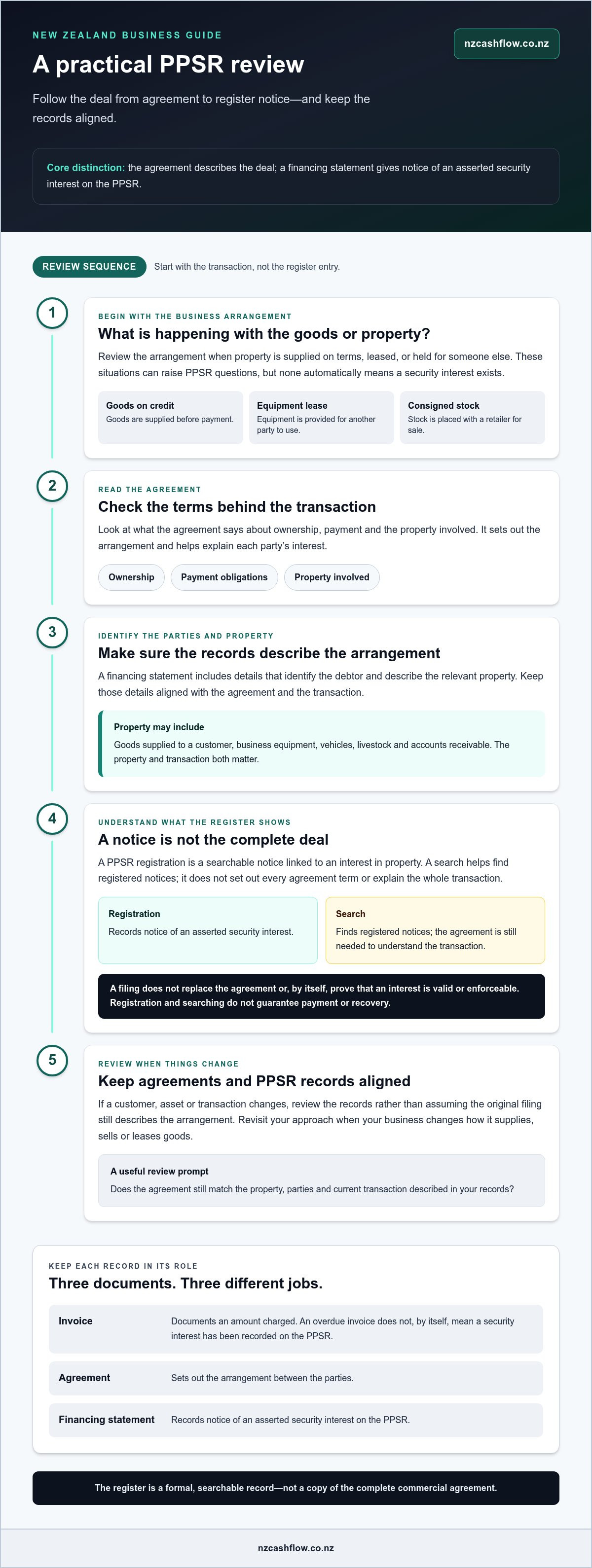
How to decide when your NZ business should review the PPSR
Use this review sequence when a transaction involves goods, equipment or other property. It won’t decide the legal position for you, but it can show when your agreements and PPSR records may need attention. Treat each step as a prompt, not a definitive test.
- Check the transaction. Is the business supplying goods on credit, leasing equipment, placing stock on consignment or changing its trading terms? A new arrangement or a change to an existing one is a useful reason to review the paperwork.
- Identify the property. What goods or assets are involved? Note what the property is, who holds it and whether the arrangement has changed. This helps staff connect the transaction to the right records.
- Read the agreement. Look at the terms covering ownership, payment and the property. The agreement is the starting point for understanding the arrangement; don’t assume familiar transactions always have the same effect.
- Check the records and responsibility. Compare the agreement with the relevant PPSR information, then confirm who is responsible for keeping both accessible and up to date.
Which business transactions should trigger a review?
Build a review into processes for new credit sales, equipment leases and consignment arrangements. Revisit the position if you change how you sell or supply goods on terms, or if a key detail changes, such as the debtor, property or agreement. These are practical prompts for an internal check, not a conclusion that registration is always required.
Make the review part of the transaction workflow. For example, flag a new supply arrangement when terms are agreed, and revisit existing records when the business changes its trading model. This helps avoid relying on paperwork that no longer describes the current deal.
Who should own PPSR administration internally?
Assign a specific role to coordinate PPSR administration. Depending on how your business operates, that responsibility may sit with credit control, accounts or operations. Other staff may create or change agreements, so the person coordinating the process needs access to the relevant documents and registration records.
Set reminders for meaningful business changes and routine record reviews. Keep the process straightforward: staff should know who to tell when an agreement, debtor or item of property changes, and where supporting information is stored. The goal is a clear handover, not a complicated system.
This framework helps your team decide when to look more closely, rather than replacing detailed registration or search instructions. A consistent review process makes PPSR nz administration easier to manage alongside everyday credit control. NZ Cashflow Services supports registration, amendment, renewal and discharge, as well as PPSR administration.
PPSR support for New Zealand businesses: registration through ongoing management
Managing PPSR records is an ongoing administration task, not just a one-off filing. A business may need to register an interest, update a record, renew a registration or discharge it when the arrangement has ended and the record should be removed. Keeping these tasks connected to business records makes the process easier to oversee.
NZ Cashflow Services supports New Zealand businesses with these PPSR tasks. This practical support helps businesses manage register administration as part of their wider credit processes. It does not guarantee payment or recovery.
What PPSR tasks can business support help manage?
The four task types cover different points in a registration’s life. Registration records notice of an interest; amendment updates a financing statement; renewal extends a registration; and discharge removes a registration from the PPSR. The appropriate task depends on the transaction and current record, so keep the supporting agreement and business information accessible.
- Registration: Record notice of a security interest connected with a business arrangement.
- Amendment: Update a financing statement when relevant recorded information needs changing.
- Renewal: Continue a registration when it is approaching the end of its term and should remain in place.
- Discharge: Remove a registration when the interest has ended and discharge is appropriate.
These are administrative steps, not a decision about whether an interest is legally valid. Keep the registration aligned with the transaction, and treat changes to agreements or business records as a prompt to review the PPSR record too.
How PPSR work fits into broader credit management
PPSR administration works best alongside clear trading terms and consistent credit records. Terms of Trade set out the business arrangement, while credit-management practices help staff apply terms and organise account information. Together, these processes give your team a clearer view of the customer relationship and its supporting records.
For example, make sure the people managing customer accounts can locate the relevant agreement and know who handles PPSR record changes. When a trading arrangement changes or ends, pass that information to the person responsible for administration. A simple handover can prompt a review, renewal, amendment or discharge where appropriate.
NZ Cashflow Services provides Terms of Trade and Credit Management support, alongside PPSR registration, amendment, renewal and discharge. Get support with PPSR administration to organise the next step for your business.
Make PPSR review part of your next business check-in
Give your PPSR process a clear place in your business routine. Decide who keeps the relevant records together and which changes should prompt a review. That way, a new trading arrangement or a shift in how you supply goods can lead to a timely check rather than an overlooked task.
Keep the purpose in perspective. PPSR nz administration can support your wider credit practices, but it can’t remove payment risk or guarantee recovery. Pair consistent record-keeping with trading terms and credit processes that suit the way your business works.
NZ Cashflow Services supports businesses across New Zealand with PPSR administration, alongside Terms of Trade and credit-management services. Get practical PPSR support for your business.
A steady process makes it easier to keep records in view as your business changes. Start with one clear review step, then build from there.
Frequently Asked Questions
What does PPSR stand for in New Zealand?
PPSR stands for Personal Property Securities Register. It’s New Zealand’s online register for notices of security interests in personal property. The register is administered by the Companies Office under the Personal Property Securities Act 1999. In everyday business, PPSR can refer to both the register and the process of recording or searching a financing statement. Keep the distinction in mind when checking a transaction or maintaining records.
Is the PPSR only for large businesses?
No. Businesses of any size may encounter PPSR considerations if they supply goods on credit, lease equipment or hold stock under a consignment arrangement. A small supplier giving a customer time to pay, for example, may want to review its agreement and how the goods are treated. The key question isn’t business size, but whether the transaction and property create an interest worth reviewing under the relevant rules.
Does a PPSR registration guarantee I will get paid?
No. A registration doesn’t make a customer pay or guarantee that you’ll recover money or property. It records notice of an asserted security interest, and any outcome depends on the transaction, the records and applicable legal rules. Continue to manage credit actively: set clear payment expectations, monitor overdue accounts and keep agreements accessible. Treat PPSR nz as one part of a wider business process, not a replacement for credit control.
What kinds of property can be recorded on the PPSR?
The PPSR can relate to a range of personal property, which may include business equipment, vehicles, stock, livestock and accounts receivable. The precise treatment depends on the property and arrangement. For instance, a business dealing in machinery may need to consider different records from a business supplying goods that become stock for resale. These examples are prompts only; check current New Zealand guidance for the property involved.
Can I search the PPSR for a New Zealand company?
Yes. You can search the PPSR for financing statements associated with a company acting as a debtor, using the relevant debtor details in the search. Read the result carefully and make sure the details relate to the company you mean. A result doesn’t show the full agreement or, on its own, establish that a claim is valid. Use it as one piece of information in your checks, not the whole credit decision.
When should a business review its PPSR records?
Review records when a new trading arrangement begins or a material detail changes. That might include changing the customer account, altering the goods supplied, revising trading terms or ending an arrangement. Assign someone to notice these changes and check whether the records need attention. A clear handover between sales, accounts and operations can prevent updates from being missed as work moves between teams.
Can NZ Cashflow Services help with PPSR administration?
Yes. NZ Cashflow Services supports businesses with PPSR registration, amendment, renewal and discharge. This is practical administration, not a guarantee of payment or recovery. It can sit alongside the business’s own credit processes, with relevant agreements and account information kept in view. The service is available to businesses across New Zealand. Get support with PPSR administration.

