

What happens after a PPSR registration is filed? For many businesses, that’s where the ongoing work begins. PPSR services for New Zealand businesses can support more than the initial registration, helping manage amendments, renewals and discharges as transactions change.
It’s understandable to focus on getting a security interest registered. But incorrect details or missed maintenance can undermine the protection you intended. When you’re also managing customer credit, equipment or goods supplied on terms, PPSR administration can be difficult to keep on top of internally.
This guide explains how to match PPSR support to your transactions and their lifecycle. You’ll learn what registration, amendment, renewal and discharge support can cover, which details to prepare, and how to decide between internal management and specialist support.
Key Takeaways
- Identify the transactions and assets that may involve a security interest worth protecting.
- Match the PPSR task to the need: registration, amendment, renewal and discharge each serve a different purpose.
- Compare internal management with specialist support by considering task ownership, available time and record-keeping processes.
- Prepare transaction, party and goods details, and check them against your records before requesting support.
- Use PPSR services for New Zealand businesses to manage registration tasks throughout a transaction’s lifecycle.
PPSR services for New Zealand businesses: what are you protecting?
Start by looking at what your business supplies, lends or lets another party use, and the terms that apply. If you sell goods on credit, lease equipment or lend against personal property, the transaction may involve a security interest. That’s a reason to assess whether PPSR support is relevant, not an automatic instruction to register every deal.
The Personal Property Securities Register (PPSR) is New Zealand’s online register for recording and searching security interests in personal property. In plain English, a security interest is a right in goods or other personal property that helps secure an obligation, such as payment. It can arise through different types of commercial arrangements. For a broader overview of the register’s purpose and history, see the Personal Property Securities Register (PPSR) on Wikipedia.
The PPSR records a security interest; it doesn’t collect a debt or guarantee that goods or money will be recovered. Registration is one part of managing a transaction. The terms, property involved, accuracy of the registration and any competing interests may all matter to its legal effect. Treat the register as a practical record, not a promise of payment, priority or return of goods.
Which business transactions may make PPSR support relevant?
Consider a supplier that provides stock before an invoice is paid, a business leasing equipment to a customer, or a lender advancing funds in connection with goods. Each arrangement may involve an interest in personal property. Whether registration is relevant depends on the goods and transaction terms, so don’t rely on the transaction label alone.
Use these examples to identify transactions for closer review, not to determine your legal rights. The agreement, the parties’ obligations and the property involved shape the assessment. To get started, note what goods are involved, who holds them and what the payment or return terms say. That gives PPSR services for New Zealand businesses a clear transaction to work from.
What a PPSR registration can and cannot do
A registration places information about a claimed security interest on a public register. It can help make that interest visible to people searching the PPSR, but it doesn’t itself enforce contract terms, recover an overdue balance or arrange the return of property. Those steps are separate from recording the interest.
Accuracy matters. Debtor details and descriptions of the relevant property need careful attention, while competing interests can affect the outcome if a dispute or insolvency arises. The legal effect depends on the circumstances and applicable New Zealand law. Don’t assume that ownership wording alone, or a PPSR entry alone, settles what happens if a customer defaults. Where the legal position is uncertain, get appropriate legal advice alongside practical PPSR administration.
This distinction helps frame the service decision: identify the transaction and the interest you intend to protect, then consider the registration task and the information needed to handle it accurately. Registration may support a broader credit-management process, but it isn’t a substitute for sound terms, accurate records or follow-up on unpaid accounts.
What PPSR services cover: registration and ongoing maintenance
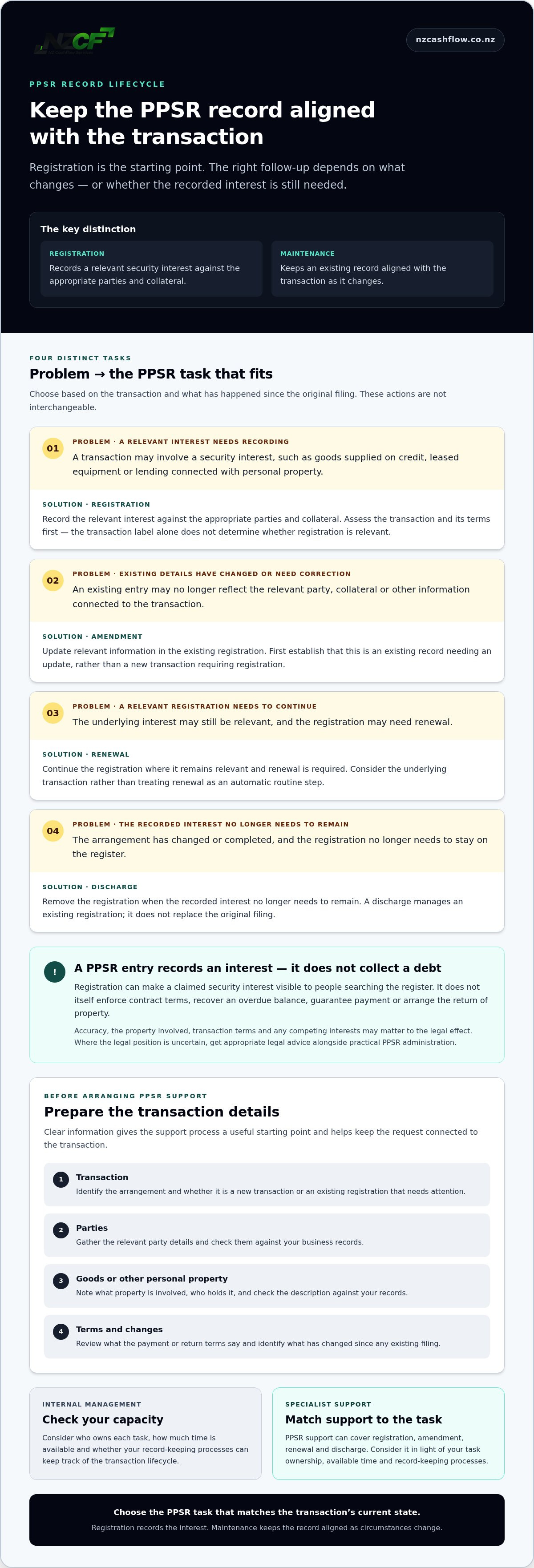
PPSR support can cover the full record lifecycle: registering an interest, changing details, renewing a registration where needed, and discharging it when it’s no longer required. The right task depends on the transaction and what has changed since the original filing.
Registration records the interest; maintenance keeps the record aligned with the transaction as it changes. This distinction helps you decide whether you need a one-off filing or support that continues over time. The official New Zealand PPSR information explains the register and its role. For a practical view of the service lifecycle, consider each task separately:
- Registration: Records a relevant security interest against the appropriate parties and collateral.
- Amendment: Updates relevant information when details in an existing registration need to change.
- Renewal: Continues a registration where it remains relevant and renewal is required.
- Discharge: Removes a registration when the recorded interest no longer needs to remain on the register.
These are distinct actions, not interchangeable options. A new transaction may call for registration, while a change to a party or collateral detail may point to an amendment. A completed arrangement may call for a discharge. Match the task to the actual change instead of treating every PPSR request as a fresh filing.
When businesses may need registration or an amendment
Registration is the initial step of recording a relevant interest against the appropriate parties and collateral. An amendment updates information when a relevant detail changes or needs correction. The aim is to keep the record connected to the transaction it relates to, rather than relying on an old entry that may no longer reflect the arrangement.
Procedural filing steps are covered in the PPSR registration in New Zealand: Guide for businesses. For service planning, first establish whether you’re dealing with a new transaction or an existing record that needs an update. That distinction gives your PPSR support a clearer starting point.
Why renewals and discharges belong in the service picture
Renewal and discharge both manage an existing registration, but they serve different purposes. Renewal keeps a relevant registration current where renewal is needed. Discharge removes a registration when it no longer needs to remain recorded. Neither action replaces the original registration, and neither should be treated as routine without considering the underlying transaction.
Build record management into your process from the start. Keep a clear link between each registration and its transaction, note later changes, and review whether the record still reflects the arrangement. PPSR services for New Zealand businesses can help manage registration, amendment, renewal and discharge as separate tasks across that lifecycle. To arrange support with these PPSR tasks, explore PPSR support from NZ Cashflow Services.
Manage PPSR tasks internally or use specialist support?
There’s no single right way to manage PPSR administration. A business with a capable team member, clear procedures and time to maintain records may manage tasks internally. Specialist support can help when administration competes with other priorities or you want help handling registration and ongoing maintenance as defined tasks.
Compare the day-to-day responsibilities, not just the initial filing. The New Zealand Government PPSR Overview provides general information about interacting with the register. Your process still needs to fit your transaction flow and make clear who can supply accurate details.
| Consideration | Managed internally | Specialist support |
|---|---|---|
| Internal time | Staff complete and maintain PPSR tasks alongside other duties. | Defined administration can be handled as a service, reducing the work your team manages directly. |
| Task ownership | Assign a clear owner for each filing and any later changes. | Coordinate the required task with the support service and provide transaction information. |
| Record monitoring | Set a process to review registrations and identify when they may need attention. | Include maintenance needs in the support arrangement, alongside the original filing. |
| Support needs | Works when staff have the knowledge and confidence to follow the process. | Can suit a business that needs practical help with repeat administration or task-specific support. |
When an internal PPSR process may suit
Self-management can work well when someone in your team understands the register and can apply your process consistently. Make ownership explicit: identify who supplies transaction details, who completes the task and who follows up if the arrangement changes. A maintained record of decisions and registrations can help the team act consistently as staff or workloads shift.
Check that your process covers more than the initial filing. If no one is responsible for noticing relevant changes or reviewing existing records, decide how to address that gap before relying on an internal approach.
When external PPSR support may be useful
Consider specialist support if staff time, confidence or repeated administration is becoming a constraint. A defined service can help organise registration and maintenance tasks without requiring your team to manage every procedural detail itself. PPSR services for New Zealand businesses can support these tasks, while your business remains responsible for supplying clear, accurate information about the transaction and relevant parties.
Outsourcing doesn’t transfer the underlying commercial decision or guarantee a particular result. Registration isn’t a guarantee of payment, priority or recovery. Choose the approach that gives each task a clear owner and keeps the information supplied tied to the actual transaction. If practical support would help, explore PPSR support from NZ Cashflow Services.
Prepare your business before arranging PPSR support
A clear starting point makes PPSR support more useful. Before arranging a registration or maintenance task, gather the basic facts about the transaction and decide what you need done. You don’t need a universal document pack. The information required depends on the arrangement, the property involved and whether you’re requesting a new registration, an amendment, a renewal or a discharge.
Use this sequence to organise the information:
- Identify the transaction. Note what the arrangement is for, when it began and what obligation the goods or assets relate to.
- Name the parties. Identify the debtor and the party whose interest is being recorded. Use the correct legal or business details in your records.
- Describe the goods or assets. Record what property is involved and any relevant identifying details, such as a serial number where applicable.
- Locate relevant documents. Gather the agreement, terms or other records that explain the transaction and the parties’ responsibilities.
- Clarify the task. Decide whether this is a new registration or a request to change, renew or discharge an existing record.
Accuracy matters. A mismatch between your transaction records and the details supplied for a registration can create avoidable uncertainty. Check names and property descriptions against source documents rather than relying on memory or copying details from an unrelated transaction. If information is missing or inconsistent, flag it early instead of guessing.
Gather the transaction and party details
Start with the debtor, the secured party and the commercial arrangement behind the proposed registration. Then identify the goods or assets connected with it and locate the supporting agreement or terms. Keep records that explain what was supplied, financed or leased close at hand. The exact information needed depends on the transaction and the PPSR service you’re arranging, so treat this as a preparation guide, not a fixed checklist.
Clarify the task and any existing PPSR records
For an existing record, note the details you have and what has changed. That could be a change to party or collateral information, a need to renew, or a completed arrangement that may call for discharge. If you’re unsure whether a record exists or which task fits, write down what you know and what remains unclear. This gives the service request a practical focus.
Also flag relevant changes, possible overlapping registrations or uncertainty about the transaction. Don’t assume an old record matches a new arrangement, or that a new filing is the right response to every change. These notes help distinguish an administrative request from a question about the underlying legal position. PPSR services for New Zealand businesses are easier to organise when the task is clearly defined and the transaction information is ready to review.
Once you’ve gathered what’s available, you can arrange support with a clearer brief. Arrange PPSR support from NZ Cashflow Services for registration, amendment, renewal or discharge assistance.
How NZ Cashflow Services supports PPSR needs
Once you’ve identified the transaction and gathered the relevant details, match the work to the PPSR task. NZ Cashflow Services supports businesses across New Zealand with registration, amendment, renewal and discharge. This provides a practical pathway for a new filing and later administration, based on what your transaction requires.
Match the service request to the PPSR task
Use the change or need in front of you to identify the likely task. A new transaction may call for registration. If information in an existing record needs updating, consider an amendment. If an existing registration needs to continue, a renewal may be relevant. If the recorded interest no longer needs to remain on the register, a discharge may be appropriate.
Bring the task together with the transaction information you prepared: the parties, goods or assets, supporting agreement, and any existing registration details or changes. This keeps the request focused. If you’re unsure which administrative task fits, outline what has happened and what you need the record to reflect. The legal effect of an interest depends on the circumstances, so PPSR administration should not be treated as a determination of legal rights.
NZ Cashflow Services’ PPSR support covers these administrative tasks. It isn’t legal representation, and registration or maintenance can’t guarantee payment, priority or recovery. If your wider concern is managing customer credit or unpaid accounts, related credit-management support may also fit into your business process.
Take the next step with NZ Cashflow Services
Before arranging support, keep your request concise. Summarise:
- The business transaction behind the security interest.
- The parties and property involved, using the details available in your records.
- The task you believe is needed: registration, amendment, renewal or discharge.
- Any existing registration details or changes that could affect the request.
This short brief connects the administrative task to the transaction without requiring a universal document pack. Share accurate information, flag gaps or uncertainties, and keep a record of the service request alongside your transaction documents.
For practical PPSR services for New Zealand businesses, explore the support that matches your task. Explore PPSR services for your business with NZ Cashflow Services.
Build PPSR decisions into your next transaction
Make PPSR a deliberate part of how your business manages credit, rather than an administrative task remembered after a deal is underway. Set a clear point in your transaction process to consider whether an interest needs recording, who owns the next step and where the supporting information will be kept.
A simple process can make future requests easier to organise. It also gives your team a consistent way to flag changes and decide when specialist administration may help. PPSR services for New Zealand businesses can support that work, while your business remains responsible for providing accurate transaction information and making informed decisions about its commercial arrangements.
Review a current transaction, identify the PPSR task you need and gather the relevant details. Explore PPSR services for your business with NZ Cashflow Services to arrange support for registration, amendment, renewal or discharge.
Frequently Asked Questions
Does PPSR registration guarantee that my business will get paid?
No. Registration doesn’t make a customer pay or guarantee that your business can recover money or goods if they default. The result can depend on the agreement, the property involved, other interests and the circumstances at the time. Treat a PPSR entry as one part of managing a credit transaction, alongside clear payment terms, reliable records and a process for following up overdue invoices.
Is the PPSR only relevant to banks and lenders?
No. Suppliers, lessors and other businesses may also have interests connected with personal property. For example, a wholesaler supplying stock on credit or a company hiring out equipment may need to consider whether its transaction creates an interest that could be recorded. The business type alone doesn’t decide the answer. Look at the agreement, the goods and the obligations between the parties.
Can a business register a security interest in goods supplied on credit?
It may be relevant, depending on the transaction and the rights created by its terms. A supplier should review how the agreement deals with payment and the goods, rather than assuming that supplying on credit automatically means a registration is appropriate. PPSR services for New Zealand businesses can assist with registration administration, but they don’t determine whether a particular arrangement creates an enforceable interest.
Does the PPSR cover land or buildings?
No. The PPSR concerns personal property, not land or buildings. It may be relevant to movable business property, but goods attached to land can raise more complex questions about how they’re treated. If an asset is fixed to premises or forms part of a building, don’t assume it should be handled like ordinary movable equipment. Get advice suited to the specific property and transaction.
What is the difference between a security interest and a PPSR registration?
A security interest is the underlying interest connected with an obligation, such as payment under a business arrangement. A PPSR registration is the entry made on the register to record that interest. For instance, an agreement may set out rights relating to equipment supplied to a customer, while a registration records relevant information about the claimed interest. The entry and the underlying agreement are not the same thing.
Can a business manage its PPSR registrations without a service provider?
Yes. A business can manage its own PPSR tasks if it has the capability, access and processes to do so. Assign responsibility for entering transaction details, keeping records and responding to changes. For example, a business might include PPSR checks in its regular credit administration. If that work becomes difficult to manage consistently, specialist administration is another practical option.
What information should I prepare before requesting PPSR support?
Start with the transaction, the debtor and secured party, and a clear description of the goods or assets involved. Locate the agreement or terms that explain the arrangement. If there’s already a registration, gather any details you have and note what has changed or what task you think is needed. The information required varies, so flag gaps rather than guessing or relying on unrelated records.


